
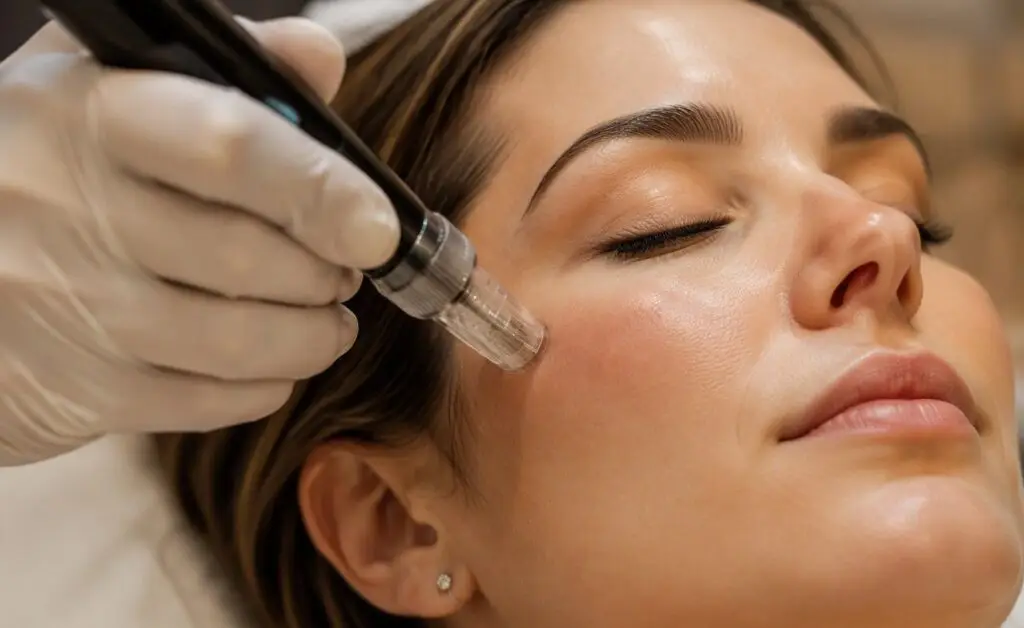
If your breakouts are finally under control but the texture they left behind isn’t, you’ve probably searched for microneedling for acne scars.
It’s one of the most talked-about approaches to improving depressed acne scarring and uneven texture.
But there’s an important catch:
Not every “acne scar” is actually a scar.
Not every type of acne scar responds the same way.
And not every collagen-induction treatment called “microneedling” is identical.
At Glow Up Studio in Dallas, we offer ProCell Microchanneling, a professional cosmetic treatment designed to support smoother, more even-looking skin through controlled microchanneling.
For deeper acne scars, medical microneedling or other dermatologist-performed procedures may be more appropriate.
Before you spend money on any acne-scar treatment, the most important first step is figuring out what you’re actually trying to improve.
Microneedling vs. Microchanneling: What’s the Difference?
Microneedling and microchanneling are related treatments, but the terms shouldn’t automatically be used interchangeably.
Both use very small needles to create controlled channels in the skin, stimulating a natural repair response that can support collagen production and improve the appearance of texture over time.
Traditional microneedling devices often use a pen-style mechanism with needles moving across the skin.
ProCell Microchanneling, which we offer at Glow Up Studio, uses a stamping-style delivery method to create controlled channels vertically in the skin.
Treatment depth, device, technique and whether the service is cosmetic or medical can all affect what concerns a treatment is capable of addressing.
That’s particularly important when we’re talking about acne scars.
How Can Collagen-Induction Treatments Help Acne Scars?
Some acne scars form because inflammation damages collagen during the healing process, leaving an indentation in the skin.
Collagen-induction treatments create controlled micro-injuries that trigger the skin’s natural repair process.
Over time, newly produced collagen may help improve the appearance of certain depressed scars and make overall texture look smoother.
This is a gradual process.
The goal is not to “remove” a scar in one appointment.
It’s to support remodeling of the skin over time.
First: Is It an Acne Scar or a Dark Mark?
This is one of the biggest sources of confusion.
If the area left behind after a breakout is flat but darker, brown, red or pink, you may primarily be looking at post-breakout discoloration rather than an indented acne scar.
If you can actually see or feel a depression in the surface of the skin, you’re more likely dealing with textural scarring.
Why does this matter?
Because the treatments are different.
Post-breakout discoloration may respond to professional skincare, chemical peels and other brightening treatments.
Indented texture may require collagen-focused treatment.
Many people have both.
That’s why we recommend assessing the skin before choosing a service.
What Types of Acne Scars Are There?
Indented acne scars are often described as rolling, boxcar or icepick scars.
Understanding those basic categories helps explain why one treatment cannot produce the same result on every scar.
Rolling scars
Rolling scars tend to look like broad, shallow depressions that create a wavy or uneven appearance across the skin.
Because they are relatively shallow, certain rolling scars may respond better to collagen-induction treatments than very deep, narrow scars.
Boxcar scars
Boxcar scars are more defined depressions with visible edges.
Their depth can vary significantly.
Shallower textural irregularities may be appropriate for cosmetic resurfacing, while deeper boxcar scars may require more advanced treatment from a dermatologist or medical aesthetic provider.
Icepick scars
Icepick scars are narrow, deep depressions.
Because of their depth and structure, these scars may require specialized medical procedures rather than relying on cosmetic microchanneling alone.
Raised or keloid scars
Raised scars are fundamentally different from depressed acne scars.
If you develop hypertrophic or keloid scars, seek medical guidance before pursuing collagen-stimulating cosmetic treatment.
Does Microneedling Work for Acne Scars?
Microneedling and related collagen-induction treatments may improve the appearance of certain depressed acne scars.
But “does it work?” isn’t quite the right question.
The better question is:
Is this the right treatment for the type and depth of scarring I have?
Someone with mild, shallow texture has a very different starting point from someone with deep icepick scars.
And the appropriate treatment may be different.
At Glow Up Studio, ProCell Microchanneling is a cosmetic skin-resurfacing treatment.
We aren’t going to tell someone with significant deep scarring that a cosmetic treatment will produce the same results as procedures available in a medical practice.
If we think your scars need something beyond our scope, we’ll tell you.
What Is ProCell Microchanneling?
ProCell Microchanneling is designed to create controlled microchannels in the skin using a stamping technique.
This process stimulates the skin’s natural renewal response and can be used to improve the appearance of:
- Uneven texture
- Mild textural irregularities
- Dull-looking skin
- Fine lines
- Overall skin quality
- Certain shallow acne-scar concerns
At Glow Up Studio, ProCell is part of our advanced skincare offering for clients who want more than a traditional facial but whose concerns remain appropriate for cosmetic treatment.
Your esthetician will evaluate your skin before determining whether ProCell makes sense for your goals.
Can You Treat Active Acne With Microchanneling?
Active acne and acne scarring are two different treatment phases.
When skin is significantly inflamed or actively breaking out, the priority is usually getting the active condition under better control before focusing aggressively on residual texture.
That might involve customized acne facials, professional skincare, chemical peels when appropriate or medical dermatology care.
Once active breakouts are better managed, we can reassess what remains.
Sometimes what looked like severe “scarring” while the skin was inflamed is actually a combination of discoloration, inflammation and texture.
Treat the acne first.
Then evaluate the scars.
How Many Treatments Will I Need?
There is no responsible universal number.
The treatment plan depends on:
- The type of texture or scarring
- Scar depth
- How widespread it is
- Your skin
- The specific treatment being performed
- How your skin responds
- Your goals
- Whether other treatments are also part of your plan
Collagen remodeling takes time, so treatments designed to stimulate collagen are generally approached as a process rather than an instant fix.
Your provider should establish an appropriate treatment schedule for the specific device and protocol being used.
Be cautious of anyone promising that a predetermined number of sessions will erase acne scars without first looking at them.
When Will I See Results?
Collagen-focused treatments are gradual by nature.
You may notice changes in the overall look or feel of your skin before you see meaningful changes in deeper texture.
And because collagen remodeling continues after treatment, evaluating results too early can be misleading.
The goal should be progressive improvement, not overnight perfection.
Photography can be helpful when evaluating acne-scar treatment because texture can look dramatically different depending on lighting.
Consistent before-and-after photos taken under similar lighting provide a much more useful comparison than checking your skin in five different mirrors every day.
Will Microneedling Completely Remove Acne Scars?
No responsible provider should promise that.
Collagen-induction treatments may soften the appearance of certain acne scars and improve overall texture, but they cannot guarantee completely scar-free skin.
The depth and type of scar matter.
So does the treatment being performed.
A cosmetic microchanneling treatment is also not equivalent to every medical acne-scar procedure available through dermatology.
Our goal at Glow Up Studio is to recommend treatments where we believe we can genuinely improve your skin — not to pretend every concern belongs on our treatment menu.
What About Dark Marks Along With Acne Scars?
This is extremely common.
You may have depressed texture and brown or darker-looking post-breakout marks in the same area.
Those are two different concerns.
Your skincare plan might therefore include different treatments at different points.
Professional chemical peels may be considered for post-breakout discoloration and uneven tone.
ProCell Microchanneling may be considered when appropriate for texture and overall skin quality.
Other facials may be used to maintain hydration and skin-barrier health between more corrective treatments.
The answer isn’t necessarily doing everything at once.
It’s sequencing treatments intelligently.
Can You Combine Chemical Peels and Microchanneling?
Both may have a role in a longer-term skincare plan, but that doesn’t mean they should automatically be stacked together.
Your skin needs time to recover from professional resurfacing.
Your esthetician should determine the appropriate spacing between treatments based on your skin and the specific services being performed.
When someone has both discoloration and texture, we can build a plan that addresses each concern without unnecessarily overwhelming the skin.
What Should You Do Between Treatments?
Your home routine matters.
Protect your skin from the sun
Broad-spectrum SPF is especially important when you’re undergoing professional resurfacing treatments.
Follow your aftercare
The products and activities you should avoid after treatment depend on the procedure performed.
Follow the specific aftercare instructions provided for your appointment rather than relying on a generic internet timetable.
Don’t over-exfoliate
Your skin doesn’t need a professional resurfacing treatment followed by every acid and scrub in your bathroom.
Give it the environment it needs to recover.
Keep us informed
Tell your provider about prescription skincare, retinoids, medications, recent procedures and changes in your skin before treatment.
Those details can affect whether a service is appropriate.
When Should You See a Dermatologist for Acne Scars?
Some acne scars simply require tools beyond a facial studio.
Consider a dermatology or medical consultation if you have:
- Deep icepick scars
- Significant deep boxcar scars
- Raised or keloid scars
- Severe or widespread scarring
- Ongoing cystic or painful acne
- Scarring that hasn’t responded to cosmetic treatments
- A concern that you’re unsure is actually an acne scar
Medical acne-scar treatment can include procedures that aren’t offered in an esthetic studio.
Sometimes the best thing we can do for your skin is tell you that another provider has the better tool.
Microneedling for Acne Scars in Dallas: Start With an Assessment
If you’re searching for microneedling for acne scars in Dallas, don’t begin by buying a package.
Begin by understanding your scars.
Are they actually scars or post-breakout discoloration?
Are they shallow or deep?
Is your acne still active?
Would cosmetic microchanneling be appropriate, or do you need a medical scar-treatment approach?
At Glow Up Studio in Dallas, we offer ProCell Microchanneling along with professional chemical peels, HydroLux, customized facials and professional skincare.
That means Glow Up Studio in Dallas we can look at the bigger picture instead of trying to make one treatment solve every problem.
Glow Up Studio is located in Inwood Village at 5525 W Lovers Lane in Dallas, Texas.
Book your skin consultation at Glow Up Studio and let us help you determine the right next step for your skin.
Microneedling for Acne Scars FAQs
Does microneedling work for acne scars?
Microneedling and related collagen-induction treatments may improve the appearance of certain depressed acne scars by stimulating the skin’s natural remodeling response. Results depend heavily on scar type, depth and the treatment being performed.
Is microchanneling the same as microneedling?
They are related collagen-induction approaches but are not necessarily identical. Devices, needle delivery, treatment depth and protocols can differ. Glow Up Studio offers ProCell Microchanneling rather than traditional medical microneedling.
What type of acne scars respond best to microneedling?
Certain shallow, depressed scars may be better candidates for collagen-induction treatments than deep icepick scars, raised scars or significant deep scarring. A professional assessment is important before choosing treatment.
How many microneedling sessions do you need for acne scars?
There is no universal number. Treatment frequency and number of sessions depend on the type and depth of scarring, treatment being performed, individual skin response and goals.
Does ProCell Microchanneling help acne scars?
ProCell Microchanneling may help improve the appearance of mild textural irregularities and certain shallow acne-scar concerns by supporting collagen remodeling and overall skin renewal. Deeper scars may require medical treatment.
Can I get microchanneling while I still have acne?
If you have significant active or inflamed acne, your provider may recommend addressing the breakouts first before focusing on scar resurfacing. The appropriate sequence depends on your skin.
Does microneedling help acne dark spots?
Dark or red marks left after acne are different from depressed acne scars. Pigmentation may respond better to treatments such as professional chemical peels and targeted skincare, while collagen-induction treatments primarily address texture.
Can darker skin tones have microchanneling?
Microchanneling may be appropriate for a range of skin tones, but every resurfacing treatment should be selected based on the individual’s skin, pigmentation history and risk of post-inflammatory discoloration. A professional consultation is the best starting point.